
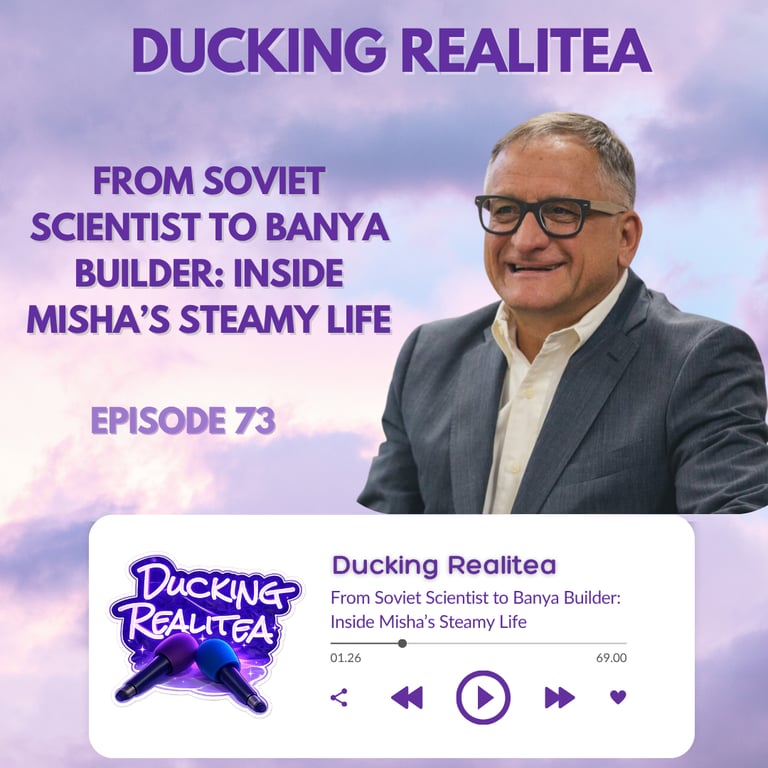
From Soviet Scientist to Banya Builder: Inside Misha’s Steamy Life
Two doctorates, one escape from the Soviet Union, and a lifelong obsession with sweating it out.
Misha breaks down everything, from Cold War science to why your sauna probably sucks, and why the real magic of the banya isn’t the heat… it’s the people.
Summary
This week, Siobhan sits down with Dr. Misha Brodsky, a man with two doctorates (applied mathematics and geophysics), a Soviet past, and a present built around hot steam, cold plunges, and human connection.
Misha traces his journey from Moscow under the Soviet Union, where travel was forbidden, careers were essentially caste-based, and he wasn’t allowed to teach because he refused to join the Communist Party, to the moment everything changed: “You can go, but you go forever.” He leaves, loses his citizenship, and rebuilds a life in the U.S., working at UC Berkeley before eventually moving into teaching and administration at Lincoln University, just as shifting visa policies begin quietly choking out small schools like his.
From there… the story heats up.
Misha breaks down the science, culture, and soul of the Russian banya, why most saunas are built wrong, why ventilation matters more than temperature, and why he hasn’t missed a Sunday in decades. What starts as a conversation about steam turns into something deeper: education, inequality, power, superstition, and the environments that actually make people feel good.
Because for Misha, the banya isn’t just about heat, it’s about the community..
Part political history, part science lesson, and part love letter to the banya, this episode explores what happens when you strip everything down, sometimes even your clothes, and remember what it feels like to be human.
Dr. Mikhail “Misha" Brodsky
Dr. Misha Brodsky is a Russian-born mathematician, geophysicist, and all-around fascinating human with two doctorates in applied mathematics and geophysics. He grew up in the Soviet Union, spent over a decade as a researcher at UC Berkeley working on complex inverse problems and earth science, and now the President of Lincoln University in Oakland, keeping a small, international school alive through some very real policy chaos.
He’s also the driving force behind Archimedes Banya in San Francisco, one of the most beloved communal sauna spaces in the country. Built with a deep understanding of heat, air, and human behavior, Misha’s banya isn’t just about sweating, it’s about connection, mental reset, and creating a space where people actually feel good.
For him, this isn’t a trend. It’s a way of life he’s been showing up for every Sunday… for decades.
💡 Key Takeaways
Life under the Soviet Union vs. the US
Travel restrictions, loss of citizenship, and the emotional cost of leaving “forever”
How Soviet “caste-like” structures predetermined careers based on family background
Science, Research, and the Limits of Individualism
Misha’s major contributions: using Earth’s vibrations and gravity fields to infer internal structure and locate resources
How moving to the US meant losing his scientific “school” and being forced into lone-wolf research and coding
What Education Is Really For
Sharp critique of mass higher education as “party colleges” and degree inflation
Ideas like draft-style service, professional/vocational tracks, and even paying parents for kids’ grades
The difference between undergrad (answer questions) and grad-level thinking (generate good questions)
The Banya as Science, Culture, and Therapy
What makes a Russian banya distinct: stove design, humidity, and true ventilation
Physical benefits: cardio load, lower blood pressure, endorphins—if there’s enough oxygen
Mental and social benefits: joy, mood shifts, and a unique form of communal intimacy
Power, Empire, and Energy
Why Russia’s imperial mindset drives expansion and war more than money
Critique of electric cars without clean generation, and a provocative case for nuclear power and hydrogen fuel
“The most difficult thing is not answering questions, it’s asking the right ones.”
– Dr. Brodsky
Lincoln University (Oakland, CA) – The small, historically international university where Misha serves as President, navigating major shifts in U.S. education and visa policy.
🔗 https://www.lincolnuca.eduUniversity of California, Berkeley – Where Misha spent 11 years as a researcher and later taught statistics.
🔗 https://www.berkeley.eduArchimedes Banya – The Russian-style banya at the heart of this episode, known for its authentic stove design, ventilation, and strong community culture.
🔗 https://banyasf.comThermë Group / Thermë USA – Large-scale sauna and wellness developments (aka “Disneyland for adults”) shaping the future of the industry.
🔗 https://thermegroup.comChernobyl Disaster & Fukushima Daiichi Nuclear Disaster – The two major nuclear events referenced in the conversation that continue to shape global perception of nuclear energy.
Traditional Russian banya culture – A centuries-old communal bathing practice rooted in Roman, Byzantine, and Slavic traditions, centered around heat, steam, and social connection.
Finnish sauna research – Ongoing observational studies (primarily from Finland) exploring the cardiovascular, mental health, and longevity benefits of regular heat exposure.