
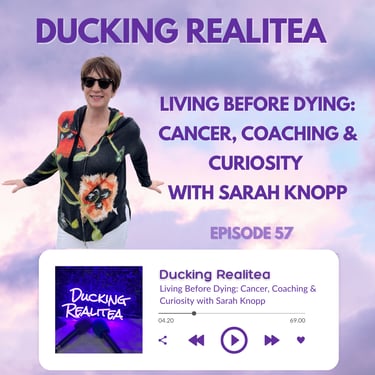
Living Before Dying: Cancer, Coaching & Curiosity with Sarah Knopp
What do you do after doctors tell you that you’re going to die… and then you don’t? In this raw, hilarious, and gut-punch real conversation, Sarah Knopp shares how metastatic cancer, chemo, brain surgery, and chronic pain turned her into a no-BS cancer coach who teaches people how to actually live before dying.
Summary
This episode of Ducking Realitea dives headfirst into the messy, funny, terrifying, and strangely beautiful reality of living with metastatic cancer. Host Siobhan sits down with Sarah Knopp, who was told she had six weeks to live after an aggressive breast cancer diagnosis that had already spread to her liver. Eleven years, 160+ rounds of chemo, brain surgery, and a whole lot of dark humor later, she’s still here, and she’s helping others navigate the chaos.
Sarah shares how she went from traveling Europe to a Planned Parenthood exam room, from “probably a shellfish allergy” to “you’re going to die,” and how she built a life around treatment schedules, endorphin-boosting scooter rides, rubber-banded pant legs, diapers, and puppy pads. She talks frankly about diarrhea, neuropathy, sex after chemo, edibles, Ritalin, medical gaslighting, and why she estranged herself from her family to survive.
Now a certified cancer coach and budding advocate, Sarah teaches patients and caregivers how to prepare for appointments, read labs, ask hard questions, and protect their energy, without putting doctors on pedestals or themselves on the back burner. This conversation is about cancer, yes, but it’s also about boundaries, burnout, healthcare greed, psychedelics, and what happens when you suddenly realize you might actually live.
Bold, irreverent, and unexpectedly hopeful, this is an episode for anyone who’s ever faced a body that betrayed them or a system that wasn’t built for them.
Sarah Knopp
Sarah Knopp is a metastatic breast cancer survivor, certified cancer coach, and advocate who runs LivingBeforeDying.com. Diagnosed in 2014 with HER2-positive breast cancer that had already spread to her liver, she’s endured more than 160 rounds of chemo, brain surgery for an aneurysm, and a full hysterectomy—while still traveling, laughing, and swearing creatively.
A former master sommelier-in-training and world traveler, Sarah now helps cancer patients and their families navigate treatment, advocate for themselves, understand their labs, and design survivorship plans that prioritize both science and sanity. Her work centers on blunt honesty, dark humor, and fiercely practical support for those living with cancer and other chronic illnesses.
Resources & Mentions
Sarah’s Website & Work
Living Before Dying (Cancer Coaching & Advocacy): https://livingbeforedying.com
Support & Tools Mentioned
Manta Cares – cancer navigator and planning tools (the “metro map” for treatment & logistics)
Epic / MyChart-style health apps – consolidating records, labs, and scans in one place
Community acupuncture / sliding scale clinics – e.g., Berkeley community acupuncture model
Cancer support groups – especially metastatic-specific groups
Cannabis & Pain Management (brands mentioned as examples, not endorsements)
Kiva Confections – Kiva blueberries (edibles)
WILD – raspberry sativa edibles for energy
Mary’s Medicinals – patches and topicals for localized pain
Media & Ideas
Firefly Lane – TV show featuring a breast cancer storyline that mirrored Sarah’s (noted as triggering)
The Body Keeps the Score (Bessel van der Kolk) – book on trauma and how the body holds it
Discussions of Ibogaine, psilocybin, and ayahuasca for addiction and emotional healing (contextual, not medical advice)
Policy & Systems
Comparison of US vs. Germany drug pricing
References to public programs like Head Start and debates over healthcare access and subsidies
💡 Key Takeaways
“Dying is easy. Rebuilding is hard.”
~ Sarah
Accepting mortality actually reduces fear and clarifies purpose.
Humor is a survival tool, especially when illness is messy.
Patients must advocate for themselves and ask direct questions.
Doctors treat cancer; nurses and teams treat the person.
Healthcare inequity is deadly, and patients must learn to navigate it.